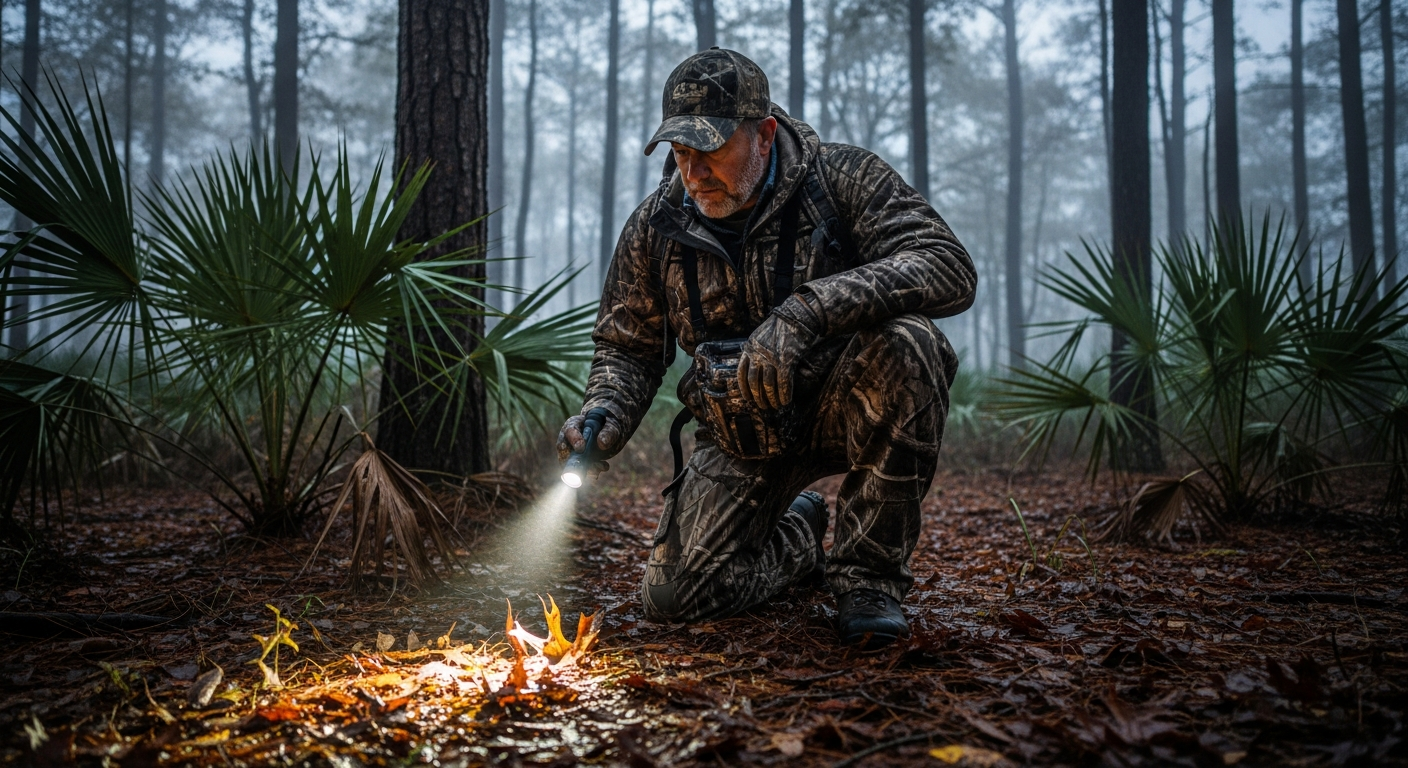
There's an old saying that gets passed around deer camps every fall. I've heard it from old men who hunted these woods long before I ever picked up a bow, and I've heard young fellas repeat it like it's written somewhere in the Bible. They'll tell you, "A dead deer ain't goin' nowhere." That's usually true, but when you're standing over the last drop of blood with daylight fading and your heart pounding, that's mighty hard advice to listen to.
I learned that lesson the hard way.
I was somewhere around thirty years old, and if you'd asked me back then, I'd have told you I knew a thing or two about tracking deer. I'd recovered enough of them to think I had the whole thing figured out. Funny how the woods have a way of humbling a man just when he starts believing he's smarter than they are.
It was one of those November afternoons that deer hunters dream about all year. The air had just enough chill to remind you fall had finally settled in, but not enough to make your hands stiff. Every little breeze carried the smell of oak leaves and damp earth, and every few minutes an acorn would hit the ground somewhere behind me. More than once I caught myself turning around because I was sure another deer had slipped in. Truth was, it was usually just another squirrel.
I was sitting in an old climber that had seen better days, overlooking a narrow oak ridge that dropped into a thick palmetto flat. If you've never hunted palmettos, count yourself lucky. They'll hide a deer standing twenty yards away, and once one decides to lie down, you could walk within arm's reach and never know he was there. Those places have fooled better hunters than me, and they're still fooling folks every season.
About an hour before dark, I caught just enough movement off to my left to make me quit breathing for a second. A nice eight-point eased out from behind a live oak like he didn't have a care in the world. He wasn't chasing does or running with his nose in the air. He was just feeding, taking his sweet time, stopping every few steps to nose through the leaves looking for acorns. Watching him settle my nerves almost as much as it sped up my heartbeat.
When he finally turned broadside, I eased my bow up, settled my pin right behind his shoulder, and squeezed the release. The arrow disappeared exactly where I was looking. That buck kicked both back legs high enough to make me grin, then lit out toward the palmettos like somebody had touched him with a branding iron.
I leaned back against that tree and smiled. "Well," I whispered to myself, "that old boy won't be hard to find."
Looking back now, I smile every time I remember saying that.
I made myself wait about thirty minutes before climbing down. Even back then I knew enough not to jump out of the stand the second a deer disappeared. When I found my arrow, it had bright red blood from one end to the other. If another hunter had been standing beside me, I probably would've told him we'd have this buck loaded before dark.
The first part of the trail only made me more confident. There was blood every few feet. Sometimes it was just a little drop no bigger than your thumbnail, and sometimes there'd be enough on an oak leaf to catch your eye from several yards away. Every step I took convinced me that buck was lying just over the next rise.
Then the trail slipped into the palmettos.
The blood got a little farther apart at first, and I didn't think much of it. That happens on a lot of deer. I found another spot, then another, and then one more about ten yards farther on. I remember thinking I'd probably see him any second.
Instead, I came to the last drop of blood.
I stood there staring at that little red spot on a palmetto leaf longer than I care to admit. I looked ahead, then behind me, then back at that leaf again like another drop was somehow going to appear if I waited long enough. It never did. I scratched my head and actually said out loud, "Well now... where in the world did you go?"
What happened over the next couple of hours taught me more about recovering deer than every easy blood trail I'd followed before it. Looking back, I didn't lose that buck because the blood disappeared. I almost lost him because I quit hunting with my head and started hunting with my feet.
I wish I could tell you I figured it out right then and there, but I'd be lying to you.
Instead of standing still and thinking things through, I did what a whole lot of hunters do when the blood suddenly disappears. I convinced myself the next drop had to be just a little farther ahead. One more step turned into ten. Ten turned into twenty. Before long I wasn't following a blood trail anymore — I was wandering around those palmettos hoping I'd stumble across a dead deer.
Now, if you've hunted long enough, you've probably done the very same thing. Don't feel bad if you have. I sure did. The problem is, the woods have a funny way of making every direction look like the right direction once you lose your point of reference. Every opening starts looking like the one the deer surely must've taken. Every little game trail begins looking promising. Before you know it, you've wandered fifty or sixty yards away from the last confirmed blood without even realizing it.
That's exactly what I did.
I spent the better part of two hours weaving through those palmettos. I'd walk a little one way, stop and look around, then head another direction because something "felt right." Looking back, there wasn't much tracking going on. I was simply chasing hope.
By the time darkness settled in, I was worn slap out. I remember sitting on an old pine log, taking off my cap, and wiping the sweat off my forehead even though the evening had cooled down. My legs were scratched up from the palmettos, mosquitoes had nearly carried me away, and I was mad enough to kick every palmetto plant between me and the truck.
That's when something my daddy used to tell me finally drifted back into my head.
He'd say, "Son, when you don't know what to do, quit doing something until you do."
Back then I thought that was just another one of those old sayings fathers liked to throw around.
Turns out, the old man knew exactly what he was talking about.
I climbed back into the truck that night without my buck, and I'll admit it bothered me something awful. I replayed that hunt in my head the whole drive home. I kept asking myself the same question over and over.
"How does a deer leave that much blood... then just disappear?"
The answer, of course, was he didn't.
The blood disappeared to me.
There's a mighty big difference between those two things.
I hardly slept that night. Every hunter knows the feeling. You close your eyes and all you can see is that last little drop of blood. You wonder if coyotes found him. You wonder if he crossed onto the neighbor's place. You wonder if maybe you made a bad shot after all. Your mind will come up with a hundred different stories before daylight if you let it.
At first light I was right back where I'd left off.
Only this time I promised myself one thing.
I wasn't taking another step until I understood what the woods were trying to tell me.
When I reached that last drop of blood, I just stood there. No rushing. No wandering. No guessing.
I looked ahead. Nothing.
I looked to my right. Nothing.
Then I slowly turned to my left.
About fifteen feet away, on the edge of a palmetto frond, sat one tiny drop of blood. It couldn't have been much bigger than the head of a kitchen match. I'd probably walked within three feet of it the evening before, but because I was in such a hurry, I never even noticed it.
That little drop changed everything.
A few yards farther was another one. Then another.
The old buck hadn't quit bleeding.
He'd simply made nearly a ninety-degree turn, and I walked right past it because I'd convinced myself he had to keep going straight.
I found him less than a hundred yards from there, tucked underneath a cabbage palm so thick you could've hidden a pickup truck behind it. He'd been dead the whole time.
I sat down beside that old buck for a long while that morning. Not because he was the biggest deer I'd ever killed, but because I knew I'd learned something I'd never forget.
That deer didn't outsmart me.
My impatience did.
Ever since that day, I've treated the last drop of blood like it's the most important clue in the whole woods. Because more often than not, it is. A deer doesn't usually vanish into thin air. We simply stop reading the story he's leaving behind.
And that's something every hunter ought to remember the next time the blood trail suddenly comes to an end.
That morning, after I finally found him under the cabbage palm, I didn't stand back up for a good long while. I just knelt there in the wet palmetto leaves with my hand on the base of his rack, listening to the morning birds start to come alive around me and the dew still sitting heavy on everything. He was a decent eight-point. Not the biggest deer I'd ever seen, but decent — and he'd been dead since the night before. Probably died within an hour of when I shot him, while I was out there in the dark chasing hope through a palmetto flat like a man who'd lost his truck keys and couldn't remember which pocket he'd put them in.
I remember thinking about my daddy then. He had a saying he liked to pull out whenever he caught me in a hurry about something — didn't matter if it was at the supper table or out in the woods or trying to finish some chore he'd given me. He'd look over with those quiet eyes and say, "Boy, the best thing about being in a hurry is how much it teaches you when it don't work out." I always thought that was just old-man talk, the kind of thing that sounds wise because it came out slow. Sitting there in those palmettos that cold November morning, I finally figured out he was right, and I've never forgotten it since.
I have thought about that buck nearly every deer season for the better part of forty years. Not because of his rack, and not because he was some great trophy — he wasn't, particularly. But because the way I found him, and everything I had to go through to get there, changed something permanent in the way I hunt. Before that November, I followed blood. After it, I started reading the whole woods, and there's more difference in those two things than it might sound like.
My grandfather could have told you that from the time I was small. He was a better tracker than my daddy, and my daddy was a better tracker than me on most days, and neither one of them would have wandered those palmettos the way I did. Granddaddy hunted this country his whole life — deer, coon, turkey, squirrel, everything that moved — and he read the woods the way some men read a newspaper, quick and naturally, without thinking too hard about it. I went with him a few times when I was young enough that he had to shorten his stride so I could keep up. I remember watching him stop once over what looked to me like a dead-ended trail and just stand there for five minutes without saying a word. When I finally asked him what he was looking at, he pointed to a spot in the leaves about twenty feet off to the right of where I'd been staring. We walked over there and there was a single smear of blood on the underside of a leaf that you would never have seen unless you'd gotten down and looked at it from below. I asked him how he knew to look there. He said, "The leaves don't lay back down by themselves." He meant the ones that were flipped over and showing their pale bellies. A running deer kicks backward with its hooves and sends leaves turning, and if you know what you're looking at, you can follow a deer for twenty yards on nothing but those pale underbellies and not a single drop of blood. He taught me that when I was about nine years old. It has put more venison in my freezer than I could count.
What I didn't fully understand until that night with the eight-point is that those overturned leaves, those little clues beyond the blood — they become everything when the blood itself goes quiet on you. And the blood will go quiet. I can promise you that. It's not a matter of whether it happens but when, and if you're not ready for it, it will send you into that same wandering panic that sent me weaving through the palmettos like a man who'd lost his mind.
The most common reason a trail disappears on a hunter isn't what most people think. It's not the rain, and it's not the dark, and it's not bad shooting, though all those things can make a hard situation harder. The most common reason a trail disappears is that the deer turned, and the hunter kept going straight. I know that sounds simple. Maybe too simple. But I've been in hunting camps my whole life and I've watched that exact thing happen to men who'd been at this for decades. A deer in trouble doesn't run in a clean, predictable line. It runs toward thick cover. It runs downhill when its legs start going out on it because downhill takes less effort. It runs toward water sometimes, whether from thirst or instinct. And it turns — hard, sudden, without any warning to the hunter behind it. You can be following a trail with good blood every few feet, and the deer cuts ninety degrees into a brush pile and you walk right past the entrance because your mind had already decided where it was going. When a trail stops on me now, the first thing I do before I take another step is stand completely still and turn slow — all the way around, including back the way I came — and look. More than once I've found the next drop of blood by looking behind me.
The other thing that stops a trail is the deer's own body doing its job. This is something most hunters don't think much about until they're standing over that last drop with nothing ahead of them. A deer's body is built to survive, and it starts working against you from the second that arrow or bullet hits. On a muscle hit — a leg, the front shoulder, the ham — the wound can clot faster than you'd believe. You'll have a strong trail for sixty or eighty yards and then it thins down to a drop here and a smear there and then nothing at all. Then there are hits where blood doesn't drain out at all because the body cavity fills up from the inside. A liver hit will do that. So will a shot that clips the far lung without opening a real exit. You get decent blood for a while because what's coming from the entry wound is enough to leave sign, and then as the inside fills up, the outside slows to nothing. I've tracked deer that looked like a garden hose had been dragged through the first fifty yards, and then spent the next hour finding nothing. The deer was dead the whole time. Just pooling instead of draining.
Pine straw is its own particular misery on top of all that. I've hunted more Georgia and Carolina pine country than I care to total up, and I still feel that little knot in my stomach when a trail heads into a big pine stand. Blood on pine straw doesn't look like blood. It soaks in fast and goes dark, and the color blends right into the brown. In good afternoon light it's hard enough. Under a headlamp it's nearly invisible unless you get all the way down on your stomach and hold your light sideways across the surface. The trick is what they call side-lighting — you're not looking for red, you're looking for a slight difference in sheen, a patch where the straw is matted slightly different, a small area where the texture is just barely off. I've been on my hands and knees over pine straw for a half hour and come up with nothing, then laid completely flat and shone my light across the surface and found four drops within arm's reach that I'd walked over twice. The blood was right there. I was just looking at it from the wrong angle.
Palmettos you already know about from this story. But I want to say one more thing about them because people who haven't hunted in palmetto country don't fully appreciate the particular way they defeat you. Those big stiff fronds don't let blood pass through to the ground. It hits the frond and sits there, on top, or on the back side, or right where the frond angles up from the stem, and if you're walking through looking at the ground you will miss it every time. In palmettos you've got to look left, right, up, down, in front, behind. Every frond within a few feet of the line you think the deer traveled is potentially hiding the next clue. I've found drops on the back side of a frond — the side facing away from the direction of travel — because the deer's body brushed it as it ran past. You'd never look there if you weren't desperate enough to look everywhere.
Hardwoods are the most forgiving of all the cover types, and I say that knowing how bad they can be when the wind picks up. Leaves hold blood well. The contrast is usually good enough to spot a drop from a few feet away in decent light. But a wind at dusk can rearrange a leaf trail completely, shuffle the drops under new leaves, cover the turned-over evidence that was telling you which way the deer went. I learned years ago that when I know I'm going to have to leave a trail and come back, I mark it as I go — not just the last blood, but every ten or fifteen yards — so I can reconstruct the line of travel in the morning even if the individual drops have been buried.
Tall grass doesn't get talked about enough. A deer bleeding from a wound low on the body drips on the tips of grass blades instead of the ground. You can follow a deer through tall grass for a hundred yards when it's bleeding reasonably well and never find a drop at your feet, because every drop is sitting on a blade tip three or four feet off the ground. You have to look where the deer was, not where you're walking. Look at the blade tips. Look for the places where the grass is bent or pushed aside or slightly matted. Look for the drops that slid down a blade and pooled at a joint. They're tiny, but they're there if you're looking for them.
Swamps have their own set of problems that I could talk about for an hour. The water washes blood off of leaves almost immediately. The ground is soft enough that you can sometimes follow tracks perfectly, but soft enough also that you're sinking with every step and starting to wonder if you're making things worse. The smell of a swamp tends to overpower everything else and makes it harder to think clearly when you're already tired and frustrated. I found a deer in a swamp once by sound rather than sign — not a loud sound, but the particular quiet of a place where something large is lying that isn't usually there. The swamp around him had gone still in a slightly different way than the swamp everywhere else. I can't explain that any better than I just did, but I know it when I feel it, and that morning it led me right to him.
Now let me tell you about the panic, because I want to talk about it honestly since it's the thing that beats more hunters than bad shots ever do.
There is something that happens inside a man in the dark woods when the trail goes cold and the hours start adding up. I've felt it more times than I like to admit, and I've watched it happen to hunters with more experience than me. It starts small — just a tightening in the chest, a little quickening in the walk. Then it starts making your decisions for you. You convince yourself the deer had to go in a certain direction. You tell yourself if you just walk a little further you'll find something. Your flashlight beam starts swinging faster and covering less ground as you move more and see less. You stop trusting the last blood because going back to it feels like admitting defeat, like taking a step backward when you should be pushing forward. A man in that state will cover twice the ground in half the time and find about a tenth of the evidence, and he'll end up standing somewhere in the dark with no idea where he is or how he got there.
The father of a hunting partner of mine — old man named Harlan who'd hunted these Appalachian foothills his whole life and had the patience of a man who'd come to terms with the fact that some things take as long as they take — told me once that panic in the deer woods is just the gap between what you expected to happen and what did. He said when you feel that gap opening up, the best thing you can do is sit down on something solid for ten minutes and close it before you move again. Not because the sitting fixes anything. But because a calm mind working the problem will find more in five minutes than a panicked one running from it will find in an hour. I've proved that to myself enough times that I believe it the way I believe in gravity.
What panic does to a tracker is pull the eyes down to the immediate ground at the boots and stop them from reading the wider woods. I've walked right past beds that way — those oval-shaped depressions in the leaves where a deer lay down, sometimes with blood in them and sometimes without — because I was staring at the ground six inches in front of my feet instead of scanning the country ahead and to both sides. A bed with blood in it is one of the most valuable things you can find on a hard recovery. It means the deer has been there, lying, which means it's hurting enough to rest, which means it's probably not far away, which means if you slow down and quiet down and move carefully, you may find it still alive and close enough to finish. I've bumped deer out of beds by moving too fast, too loud, too close, and I've watched them run in the direction I'd never have found them from. Those are the recoveries that stay with you.
And you've got to look behind you. I say this every time I talk about tracking because it still surprises people and it still costs hunters deer. A wounded animal doesn't always keep going away from you. I've had deer circle back on their own track. I've followed a trail that was clearly heading away from my stand for two hundred yards only to find the deer had looped around and died inside of a hundred yards from where I was sitting. Every now and again I'll stop in the middle of a search, completely stop moving, and just look back the way I came. What you see when you quit staring at what's in front of you is sometimes exactly what you were looking for.
There's something else to look for beyond the blood — hair. Deer shed hair constantly on every rough piece of bark, every strand of wire, every tight gap they push through fast. Hair on branches or vines tells you which way the deer went and how recently. Hair on the ground in a little clump tells you the deer was moving hard through a tight place. And the hair itself tells you something if you know how to read it. Belly hair is coarse and pale. Back hair is dark. Leg hair is thin. Coarse pale hair near the blood tells you one story. Dark guard hair tells you a different one. Granddaddy taught me to pick up a clump of hair and look at it before I moved on, because it was one more sentence in the paragraph the deer was writing about itself.
I want to say something about waiting, too, because nothing — nothing — costs more hunters more deer than not understanding it.
That eight-point of mine was a lung hit. Good blood, mule kick with both legs, ran hard and fast. On that kind of hit, you're usually safe to follow within thirty to forty minutes and you'll find the deer close. The bright frothy blood is the lung telling you what happened. But I've seen blood that looked just like that turn out to be a hit that was further back than it appeared, and I've seen blood that looked dark and terrible turn out to be a clean double-lung that bled internally and externally both. The blood is your best clue about what you're dealing with, but it's not always perfectly honest.
A hunting partner of mine shot a doe one cold October afternoon and came and got me an hour later. We walked out to the blood together. I looked at it and said I thought it was a liver hit — dark, heavy, maroon-colored, the doe had hunched when she ran. He thought it was a double-lung. We argued about it for a few minutes the way hunters do, not meanly but firmly, and we ended up following her after about ninety minutes because he was right that it was his deer to make the call on. She jumped out of a pine thicket about a hundred and fifty yards in and we never found her. I've thought about that doe many times. A liver-hit deer given four or five hours of undisturbed quiet will almost always be found within a reasonable distance. That same deer pushed while she's still running on adrenaline can go a mile, and by then you may be on someone else's land or across water you can't follow or somewhere the trail has simply gone too cold to work. The waiting wasn't a loss of time. The not waiting cost the whole thing.
Gut shot is the hardest situation I know, and the one where most hunters make the most catastrophic mistake. The blood has a smell and a color that are different from any other hit — you'll know it when you encounter it, and when you do, your stomach will drop because you'll know what you're facing. That deer needs to be left alone. Eight hours minimum. Twelve is better. If you've got cool temperatures and can leave it overnight, leave it overnight. A gut-shot deer that lies down and dies undisturbed will almost always be found within a couple hundred yards of where it fell. That same deer pushed too soon has been known to travel distances that would make a grown man want to sit down and put his face in his hands. The hardest thing you can do in that situation is walk back to the truck. It's also the thing that will most often put that deer in your truck the next morning.
There will come a night — and it'll come more than once if you hunt long enough — when you've done everything right and you still cannot find the deer. You've gone back to the last blood and marked it and circled from it and gridded the ground around it and looked at every frond, every blade, every inch of soft mud at every creek crossing within range. And the deer is simply beyond your ability to find on your own.
That's when you call a man with a dog, and you do it without shame.
I waited too long to learn that lesson. Years too long. There's a stubbornness in some hunters — I've got a generous helping of it — that says asking for help means something failed. What I know now is that a good tracking dog with a good handler can do something no human being alive can replicate with a flashlight and a good attitude. Those dogs work on information that's completely invisible to us. They're not reading the woods the way we are. They're reading something that exists in another dimension of the sensory world, something that lingers in the air and the soil long after the blood has dried and the leaves have blown back over themselves. Using one isn't admitting defeat. It's having the sense to recognize the difference between stubbornness and skill.
The first time I finally called one in — a Bavarian Mountain Hound, of all things, leashed, worked by a man who'd been doing it for thirty years — I stood and watched that dog go to work and felt something I can only describe as honest humility. The kind that doesn't sting because it comes from watching something done beautifully, not from being shown up. We had the buck in forty minutes. He was four hundred yards into a swamp I'd walked three times without finding him. The dog went straight to him, no hesitation, no back-tracking, just purpose. I shook that handler's hand and thanked him and meant every word of it.
Check your state regulations before you go looking for a handler, because leashed tracking dogs aren't legal in every state. But where they are, find a number and save it in your phone before opening day. Don't wait until midnight with your last drop of blood to start searching for help. That's too late.
I sure wish I'd had something like HuntIQ back in those early years. I want to say that plain, because it's true, and I don't say it to sell you anything. I say it because I know exactly what it felt like to stand over that last drop of blood on that palmetto frond and have nothing but a flashlight and forty years of hard lessons still ahead of me.
There's a feature inside HuntIQ called Blood Tracker that uses the camera on your phone to help you see blood evidence your eyes might be walking right past. Tiny drops on wet leaves. Thin smears on pine straw. Faint traces on palmetto fronds in the kind of low light where colors stop doing what you want them to. Now I'll be honest with you the way an old hunter ought to be honest: it's not perfect. Wet leaves and certain bark will fool it sometimes. You still have to look with your own eyes and trust your own judgment on every flag it gives you. It's a second opinion, not a verdict. But on those trails where you're on your hands and knees in the cold trying to find one more drop to keep the story going, having something that helps catch what you'd otherwise miss — I'd have been glad to have that. On more than one night I can think of specifically.
There's also a Shot Analyzer. Right after the shot, when your heart is still hammering and you're sitting in that stand trying to hold on to every detail before adrenaline rewrites the memory, this tool walks you through what you saw — where the deer was hit, how it reacted, what direction it ran — and helps you make a sensible decision about how long to wait before you go after it. That waiting decision is one of the most consequential things you'll make during a whole recovery. Having something help you think it through clearly in those first hot minutes, before your impatience starts arguing with your judgment, is worth something real.
And there's Trail Maker, which records your path with GPS as you walk. When you've been circling an area for an hour in the dark and you genuinely can't remember which ground you've covered and which you haven't, you can look at your phone and see exactly where your boots have been. When you need to find your way back to the last blood — and you will need to, more than once on any hard recovery — your trail is right there on the screen. It doesn't find the deer. Nothing finds the deer except patience and time and the willingness to read what the woods are telling you. But it keeps you from losing your anchor point in the dark, and losing that anchor point has cost hunters more deer than bad shots ever did.
None of it works without you. I want to be plain about that. A tool that isn't backed up by patience and good sense is just extra weight in your pack. The woods don't care what's in your pocket. But in the hands of a hunter who's already doing the right things — the waiting, the marking, the slow careful searching — these tools give you a little more of the margin. And in this game, margin is everything. They've got a 14-day free trial with no credit card required if you want to see what it's about.
The morning I found that eight-point, I sat with him for a long time. Long enough that the light had shifted and the dew had burned off the fronds around us and the sweat had dried on the back of my shirt. I sat with my hand on his neck and my back against the trunk of that old cabbage palm and I thought about every step I'd taken the night before that led me somewhere other than here. All the ground I'd covered searching for something that was never more than a hundred yards away. I thought about that little drop of blood on the palmetto frond — no bigger than a kitchen match head, right there where I'd walked within three feet of it and missed it completely — and how everything I needed was right there waiting for me the whole time, patient as the woods themselves, just waiting for me to slow down enough to see it.
He'd earned a name by then, in my head. I called him the Teacher. I never told anybody that because it would've sounded foolish. But that's what he was. That old eight-point with his worn hooves and his heavy neck and his eyes that had already gone still — he taught me more in one hard night than a dozen easy recoveries ever had or ever could. Easy recoveries teach you nothing except that you were lucky. The hard ones teach you everything that matters.
In the years since, I've recovered deer I had no business finding and lost deer I should have walked right up on, and the difference between those two outcomes has almost never been skill or luck or the quality of the equipment. It's been patience, every time. The willingness to go back to the last blood and trust it and work out from it slow and deliberate and honest about what the woods are actually telling you rather than what you want them to tell you. I have never once looked back on a recovery and wished I'd gone faster. Every deer I've lost, I lost because I did.
When the trail goes quiet on you, go back. Always go back to the last drop. Mark it, trust it, stand over it and let the woods settle around you before you decide what to do next. The deer is almost certainly closer than your fear thinks it is. And there is more time than your impatience believes there is. Those two lies — that the deer is far and that time is short — have cost hunters more recoveries than anything else I know. Don't believe them.
The best tracker I ever knew was my grandfather, and the thing that made him great was not what he looked for or even how he looked for it. It was that he could stand still longer than the woods expected him to. He'd just stop, and breathe, and let things come to him instead of running after them. I still see him standing there in his old canvas coat with his hands in his pockets and his eyes moving quiet and slow across the country, reading everything without appearing to look at anything in particular. That stillness was his greatest skill, and it's the one I've spent the most of my life trying to learn.
The best hunters I ever knew weren't fast. They were still.
Before you go — there's more reading that'll help put all this in context. If you want to understand what the blood itself is telling you, why some is bright red and foamy and some is dark as old coffee, the complete blood tracking guide will walk you through it from the shot to the tailgate. If you're trying to figure out how long to wait based on the hit you think you made, this guide on waiting times by shot placement is as straight as I know how to put it. If you want to understand what a deer's reaction right after the shot is telling you — so you already know what you're dealing with before you ever climb down — reading deer behavior after the shot is some of the most useful knowledge a bowhunter can carry. And if you've got rain coming in and darkness falling and a trail going cold all at the same time, tracking in rain, wind, and darkness is worth reading before you ever need it.