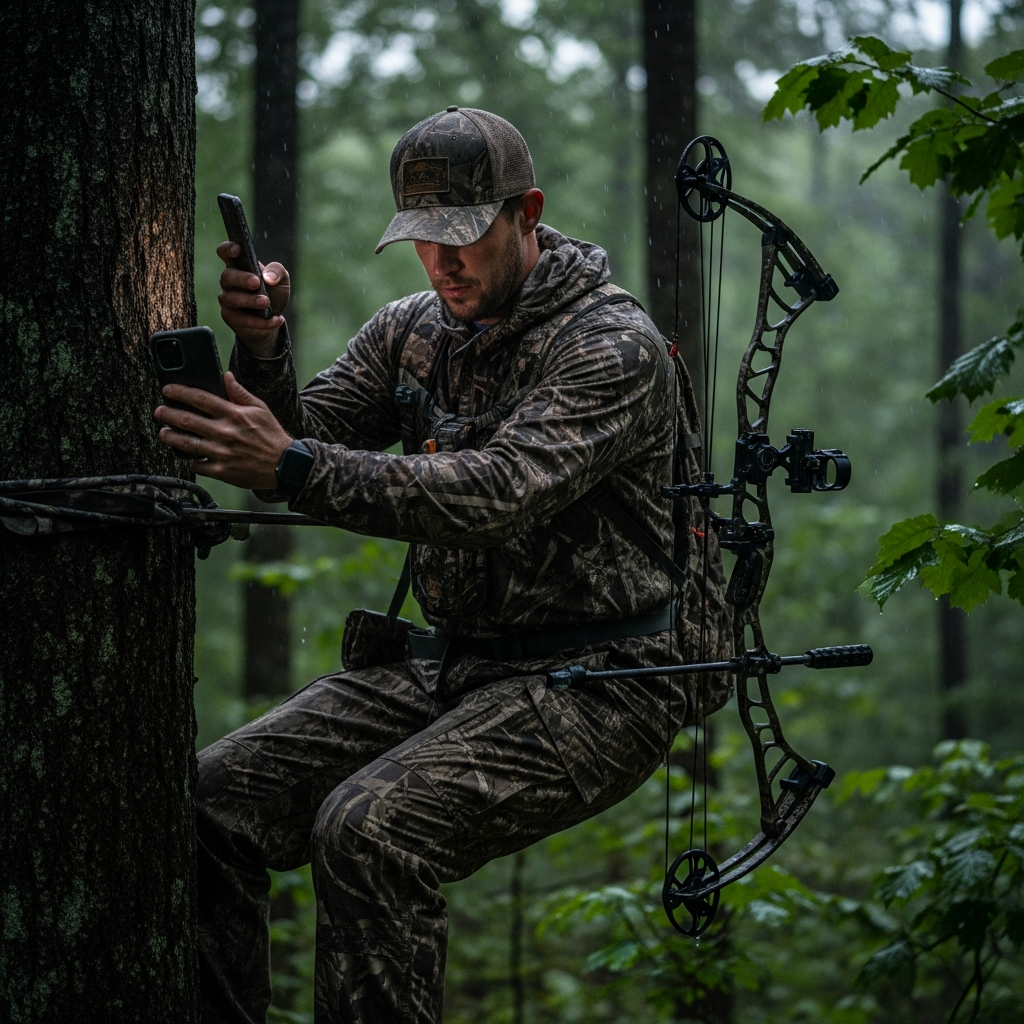
You hear that? Listen. That's rain coming. And judging by how dark it's getting... we're going to lose daylight before long too.
Now I know exactly what's going through your mind. You're thinking...
"We better hurry before the rain washes away the blood."
I used to think the same thing. Matter of fact... I made that mistake more than once.
You know what I learned?
Rain doesn't lose nearly as many deer as impatient hunters do.
That's something I wish somebody would've told me when I was your age. So before we take one step into those woods... let's talk about it. Because this is where good recoveries are won — or lost.
The Woods Don't Care That You're Nervous
Boy, if deer hunting has taught me anything... it's that the woods don't care how excited you are. The deer doesn't know it's getting dark. The rain isn't trying to ruin your hunt. Nature is just doing what nature does.
The only thing you really control now is you. You control whether you rush. You control whether you think. You control whether you push a wounded deer that was about to lie down.
That's why I tell every young hunter — the recovery starts the second the arrow hits. Not when you find blood. Not when you climb out of the stand. The moment that shot breaks, you're already making recovery decisions.
Let Me Tell You About My Biggest Mistake
Years ago, I shot a nice buck just before sunset. Good shot — or at least I thought it was.
About five minutes later I heard thunder. I looked up. Black clouds were rolling right toward me. You know what I did? Exactly what I thought I was supposed to do. I climbed down. Started tracking. Found blood almost immediately. Thought I was doing everything right.
Then the blood got thin. Then it disappeared. I wandered around trying to find one more drop. Pretty soon I wasn't following the deer anymore. I was following my own boot tracks.
That buck got up three different times before daylight the next morning. How do I know? Because we found every one of his beds. If I'd simply waited, we would've found him lying in the first one.
Instead, I pushed him almost half a mile. I recovered him — but I made it ten times harder than it ever needed to be. That deer taught me more than any magazine article ever could.
Rain Doesn't Wash Everything Away
This is probably the biggest myth you'll hear around hunting camp.
"Better hurry before the rain washes all the blood away."
Now, can heavy rain make tracking harder? Absolutely. Can a hard thunderstorm erase a lot of evidence? Sure can. But here's what surprises most new hunters: a light rain usually doesn't destroy nearly as much evidence as people think.
Blood soaks into leaves. Runs down blades of grass. Collects underneath palmetto fronds. Gets on tree bark. Spots vines. Stains pine needles. You'd be amazed how much survives if you'll just slow down enough to look.
Most hunters panic long before they actually need to.
Blood Isn't What You're Really Following
Now here's something I want you to remember for the rest of your life. You're not tracking blood. You're tracking a deer. Blood is only one clue.
Think about everything that deer leaves behind — fresh tracks, bent grass, broken sticks, leaves kicked over, mud, hair, even the way brush is pushed aside. Sometimes those clues become far more important than the blood itself. Especially after rain.
I've followed deer where I only found blood every thirty or forty yards. The rest of the trail? Tracks. Broken vegetation. Common sense. That's real tracking.
For a full breakdown of what blood color and pattern tells you, read Blood Tracking Deer: The Complete Guide to Following a Blood Trail After the Shot.
Darkness Changes Everything... Mostly Your Mind
Now let's talk about darkness. You know what darkness does more than anything else? It makes hunters hurry.
The sun starts disappearing. You look at your watch. You think... "If I don't find him before dark, I'm in trouble."
No. You're only in trouble if darkness causes you to quit thinking.
I've watched hunters walk right past dead deer because they were moving too fast to beat sunset. I've also watched hunters sit down, wait ten minutes for their eyes to adjust, and spot a white belly laying fifty yards away.
Darkness doesn't make deer disappear. It just forces you to slow down. And honestly... that's not always a bad thing.
Wet Leaves Will Fool You
Now here's another lesson. Everything shines when it's wet. Every leaf. Every stick. Every pine needle. You'll swear you're looking at blood. Walk over... nothing. Just water reflecting your flashlight.
That's why I never trust the first glance. Move around. Look from another angle. Crouch down. Stand up. Sometimes the next drop of blood doesn't magically appear — it simply catches the light differently.
The woods have a funny way of hiding things from people who are in a hurry.
Wind Doesn't Wash Away Blood — But It'll Change the Woods
Most hunters only think about the wind before the shot. After the shot? They quit paying attention. That's a mistake.
The wind won't blow blood off the ground, but it'll sure make the woods harder to read. A good breeze keeps leaves moving. Grass never sits still. Every vine and every palmetto frond seems to be dancing. Now your eyes have to work twice as hard because everything around you is moving.
Here's what I do. When the wind picks up, I stop looking for movement. I start looking for color. I'm not trying to catch something out of the corner of my eye anymore. I'm looking for that little splash of red. That dark stain on a leaf. That tiny spot on the edge of a palmetto. The wind can fool your eyes if you let it. Don't let it.
Fog Can Be Your Friend
This surprises people. Everybody thinks fog makes tracking impossible. Sometimes... it's actually easier.
Fog softens the woods. Everything gets quiet. You start slowing down without even realizing it. The only problem is your flashlight. If you've ever driven through heavy fog with your high beams on, you know exactly what happens — all you see is white. The same thing happens in the woods. Use the lowest light that lets you see comfortably. Sometimes less light lets you see more.
Water Doesn't Mean the Trail Is Over
I've heard hunters say... "He crossed that creek. We'll never find him now."
Don't give up that easy.
Think about it. If you walked through a shallow creek, would you magically disappear? Of course not. You'd leave wet tracks climbing out the other side. So does a deer.
Walk to where he entered. Look carefully. Don't just charge across. Find where he came out. You'll often see muddy hoofprints, freshly disturbed dirt, water dripping from grass — sometimes even blood where he brushed against weeds climbing the bank. Crossing water doesn't end a trail. It simply changes the kind of clues you're looking for.
Thick Palmettos Will Test Your Patience
If you've never tracked a deer through waist-high palmettos... you're in for an education. Those things hide everything. Blood. Deer. Hunters. You can walk within twenty feet of a buck and never know he's there.
This is where I tell hunters to quit staring at the ground every second. Every few steps — stand up. Look ahead. Scan slowly. You're not just looking for blood anymore. You're looking for an ear, a tine, the curve of a back, a white belly, one antler sticking through the brush.
I've found more deer by looking ahead than I ever have staring at my boots.
Here's Where Young Hunters Usually Mess Up
I've watched it happen more times than I can count. The blood gets thin. The hunter speeds up. Why? Because he thinks he's about to lose it.
Actually... that's exactly when he should slow down.
One slow step. Stop. Look. Another step. Look again. Sometimes the next drop is only six inches away. Sometimes it's on the backside of a leaf. Sometimes it's on the edge of a palmetto instead of the ground.
Blood doesn't stop being there. It just becomes harder to notice. That's where patience starts beating excitement.
Don't Walk Past Your Deer
You know something funny? Hunters spend so much time looking for blood, they forget they're actually looking for a deer.
Every thirty or forty yards — stop. Raise your head. Study the woods. I've watched people step over a dead buck because they were staring at one little drop of blood beside their boot.
Remember... the goal isn't finding blood. The goal is finding the deer. Never forget that.
Know When Pride Starts Making Decisions
Sometimes you need help. There's no shame in that. Matter of fact, the older I get, the more respect I have for hunters who know when to ask for it.
If you've spent hours looking, the blood is gone, the sign doesn't make sense, and you're beginning to guess instead of track — stop. Call someone. If tracking dogs are legal where you hunt, don't wait until you've walked all over the woods. The earlier a good dog starts, the better your chances usually become.
The deer doesn't care whose name is on the recovery picture. What matters is making an ethical recovery. Leave your pride at the truck.
Why I Keep HuntIQ Ready Before I Ever Need It
Have HuntIQ Ready Before You Leave the Stand
Preparation beats panic. Before I ever leave the tree stand, I already have HuntIQ open — not because I've lost the trail, but because I don't want to be fumbling with my phone after I do. I start Trail Maker before I take my first step, so if I have to circle back or return to the last confirmed blood, I know exactly where I've been. When those little drops become difficult to see on wet leaves or pine needles, Blood Tracker is already ready. Think of it like a tow strap — you pack it before you leave home, not after the truck is stuck. It doesn't replace good judgment, patience, or experience. It gives you another tool when rain, darkness, and thick cover start stacking the odds against you.
Try HuntIQ Free for 14 DaysDon't Chase the Weather
I've hunted through drizzle, steady rain, fog, wind, cold fronts, and Florida thunderstorms. You know what I've learned? The weather almost never ruins the hunt. Hunters do.
Every time you feel yourself wanting to rush, stop. Ask yourself one question:
"Am I making this decision because it's the right thing for the deer — or because I'm worried about the weather?"
That answer will usually tell you exactly what to do.
Darkness Doesn't Mean You're Finished
I know how disappointing it feels. You've looked for an hour. The woods are almost black. You haven't found him. Now you're wondering if you should quit.
Sometimes yes. Sometimes no. The important thing is making that decision for the right reason — not because you're frustrated or tired, but because it's the smartest move.
If you've got a strong blood trail, good lights, and you know the deer is likely dead nearby... keep going. If you're guessing, walking in circles, and stepping over sign... backing out until daylight may actually improve your chances.
There isn't a trophy for recovering a deer at midnight. The trophy is recovering him. Period.
If you're unsure how long to wait based on the hit, How Long Should You Wait After Shooting a Deer? gives you a full breakdown by hit location and conditions.
One Last Story Before We Head Home
People ask me all the time... "What's the hardest deer you ever recovered?" They expect me to tell some story about a giant buck.
Truth is, it wasn't. It was a little eight-point. Young hunter. First deer. Light rain. Almost dark. He was scared to death he was going to lose him. Every five minutes he'd ask... "Shouldn't we hurry?" Every time I'd smile and tell him... "Not yet."
We moved slow. Real slow. Stopped more than we walked. Looked ahead instead of always down. Read every clue the woods gave us.
About an hour later — there he was. Laying under a cedar tree.
The young hunter looked at me and said... "I thought the rain was going to ruin everything."
I laughed. "No, son. The rain didn't almost cost you that deer. Your excitement did."
He still reminds me of that hunt every season. Not because of the buck. Because of what he learned.
Before We Leave the Tailgate
If there's one thing I hope you remember after reading all this, it's this.
Rain doesn't recover deer. Darkness doesn't lose deer. Wind doesn't make bad decisions. Hunters do.
Slow down. Think before you walk. Trust the evidence. Be patient enough to let a wounded deer do what wounded deer naturally want to do.
And never forget — every old hunter you meet, every one of us, was once the young fellow sitting on this tailgate asking the very same questions you're asking today. The only difference between us now is somebody took the time to teach us.
Now it's your turn. One day you'll be the old hunter sitting on the tailgate, passing these lessons on to somebody else.
Keep Learning
Rain, wind, and darkness are conditions. The recovery skills underneath them stay the same. These guides will sharpen them.
- Blood Tracking Deer: The Complete Guide to Following a Blood Trail After the Shot — Everything you need to know about reading blood color, pattern, and consistency — including what to do when the trail disappears.
- How Far Will a Deer Run? What Every New Hunter Should Know Before Following a Blood Trail — Understanding distance expectations by hit location so you know when to keep pushing and when to wait.
- How Long Should You Wait After Shooting a Deer? — Detailed guidance on wait times based on hit location, weather, temperature, and conditions.
- How Deer React After the Shot: What the Mule Kick, Hunched Back, Tail, and Running Style May Tell You — Read the deer's reaction while you're still in the stand so you arrive at the impact site already knowing what you're looking for.