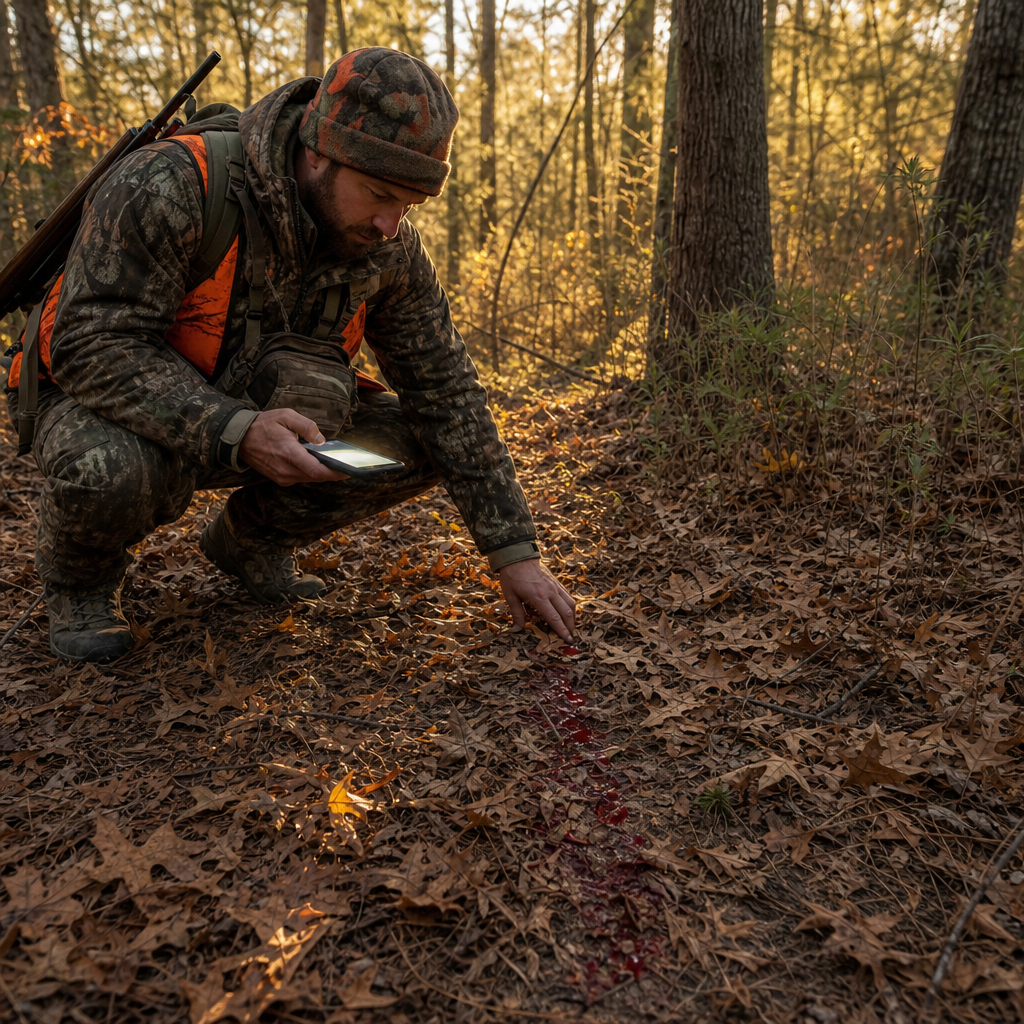
A deer does not always fall where it was shot. Sometimes the woods go quiet, the last flash of a white tail disappears through the cover, and the hunter is left standing there trying to replay a few seconds that seemed to happen all at once. Where was the deer when the shot broke? Which way was it facing? Did it jump, hunch, stumble or run as though nothing had happened? Was the sound of the hit solid, hollow or sharp? Did the arrow pass through? Was there blood at the impact site? What kind of hair was lying on the ground?
Those questions matter because recovering a wounded deer rarely depends upon one perfect clue. It depends upon noticing several imperfect clues, preserving them and understanding how they fit together.
The purpose of this guide is to help hunters read the complete scene: the deer's reaction, the location of the hit, the color and consistency of the blood, the direction of travel, the hair, tracks, disturbed vegetation, odor, stomach material, fat, bone and every other piece of evidence the woods may provide. It also explains how the HuntIQ Blood Tracker can help when blood is present but difficult to distinguish from leaves, bark, soil, shadows and other natural ground cover.
No blood color, reaction or piece of hair can identify a hit with complete certainty by itself. Shot angle, entrance and exit locations, weapon, broadhead or bullet performance, penetration, weather, terrain and individual deer behavior can all change what a hunter finds. Treat every clue as evidence, not as a guarantee.
What Is the HuntIQ Blood Tracker?
The HuntIQ Blood Tracker is a camera-based deer-recovery tool built to help hunters examine difficult blood trails in real time with a compatible phone. It reduces the visual distraction created by much of the surrounding ground cover while preserving the red and pink tones hunters are trying to locate.
That distinction matters in the woods. A tiny smear of blood may be obvious on a clean white surface but nearly disappear against wet oak leaves, rusty pine needles, dark soil, mottled bark, palmettos, grass and broken shadows. The Blood Tracker gives the hunter another way to examine the scene when the naked eye is having trouble separating blood from everything around it.
The feature includes adjustable sensitivity because every trail and every environment is different. A strong, obvious blood trail may not require the same setting as a trail made of pinhead-sized droplets. Fresh red blood, dark red blood, maroon blood, brownish-red blood, diluted pink-red blood and frothy pink blood may also appear differently depending upon moisture, lighting, age and the surface on which they are found.
The Blood Tracker is not a promise that every deer will be recovered. It cannot create blood where none exists, determine an exact organ hit from color alone or replace careful fieldcraft. It is one tool within a complete recovery process that still requires patience, judgment, marking the trail, protecting last blood and knowing when to continue or back out.
Open the HuntIQ Blood Tracker
Already subscribed? Sign in and open the Blood Tracker. New to HuntIQ? Subscribe for $4.99 per month to unlock the Blood Tracker and the complete HuntIQ deer hunting and recovery toolkit.
Subscribe NowBlood Tracking Begins Before You Leave the Stand
The first mistake in many unsuccessful recoveries happens before the hunter ever reaches the place where the deer was standing. Excitement takes over, the hunter climbs down too quickly, walks directly through the impact area and begins searching without first fixing the scene in memory.
Stay still long enough to observe.
Watch the deer for as long as it remains visible. Notice the exact direction it travels and the last place you can see its body. Do not merely remember that it ran toward the thick stuff. Choose a specific tree, forked limb, palmetto clump, fence post, rock, opening or other landmark. The view from the ground will look different from the view in a stand, and an exact landmark can keep you from beginning the search in the wrong place.
Listen after the deer disappears. A crashing sound may indicate a fall, but deer also break branches while escaping and sometimes pause before continuing. Silence does not mean the deer is unhurt. Continued noise does not necessarily mean the hit was poor. Record what you hear without forcing it to fit the result you hope for.
Pay attention to the deer's reaction, but do not make the recovery decision from that reaction alone. A mule kick is often associated with a chest hit, but not every chest-hit deer kicks and not every kicking deer was hit through both lungs. A hunched posture may raise concern about a liver or abdominal hit, but body posture can be influenced by angle, balance and the animal's immediate attempt to escape. A deer that runs hard with its tail raised may still be mortally wounded. A deer that appears badly hit may travel farther than expected.
The safest approach is to combine the reaction with the shot location, angle, sound, arrow or bullet evidence, blood, hair and the sign found along the trail.
Mark the Exact Location of the Deer and the Hunter
Before climbing down, mark two separate locations in your mind or on your mapping tool.
The first is the location from which the shot was taken. The second is the exact location of the deer when the projectile reached it.
These points are not interchangeable. Together they help reconstruct the shot angle. A broadside deer may not have been perfectly broadside. A quartering angle can move the exit far forward or far back from the visible entrance. A steep shot from an elevated stand may enter high and exit low, allowing blood to remain inside the body cavity until the exit begins leaking. A low entrance with no exit can produce a very different trail.
Once on the ground, walk to the deer's location without trampling the expected escape route. Approach from the side whenever practical. Preserve the ground immediately around the impact site because it may contain clipped hair, blood spray, tracks, bone, fat, stomach matter, the arrow or evidence of a deflection.
HuntIQ's Trail Maker can be used to preserve the hunter's route and help mark important locations, including the shot position, impact site, blood and last confirmed sign. The Blood Tracker should be used as part of that organized search rather than as a reason to wander randomly through the woods.
Before You Track, Decide Whether You Should Track
Finding blood does not automatically mean the hunter should begin following it immediately.
A deer hit through both lungs may die quickly, but a deer hit through one lung, the liver, stomach or intestines may remain alive much longer. Pushing a deer from its first bed can turn a recoverable animal into a much more difficult track. When disturbed, a wounded deer may travel into thicker cover, cross property boundaries, enter water, mix with other deer tracks or leave the area available to the hunter.
The decision to wait should be based upon all available evidence. Consider the suspected hit location, shot angle, penetration, deer reaction, blood, hair, arrow condition, weather, temperature, approaching rain, legal shooting hours, predators, property boundaries and whether a qualified tracking dog may eventually be needed.
When the evidence indicates a questionable hit, patience is usually more useful than confidence. A hunter can always resume a search after allowing time. A hunter cannot put a bumped deer back into its first bed.
For a complete discussion of recovery timing by hit location, read the HuntIQ guide to how long you should wait after shooting a deer.
Begin at the Impact Site, Not Where You Think the Deer Went
The impact site establishes the beginning of the physical trail.
Start by finding the deer's tracks where it stood. Look for sharply cut hoof impressions, displaced leaves, kicked soil and the first forceful stride. The escape track may dig more deeply into soft ground than ordinary walking tracks. In dry leaves, the track itself may be hard to see, but the direction of thrown leaves and disturbed debris can reveal the first few bounds.
Search slowly in an expanding circle around the exact location without walking through the likely line of travel. Look at ground level as well as knee and waist height. Blood may be on the underside of leaves, along grass stems, on saplings or against the side of a log. A high wound may leave very little blood on the ground but transfer blood to vegetation. A low exit may produce droplets close to the track.
Inspect clipped hair before moving it. Photograph it in place with a size reference. Hair can be blown or kicked away after the shot, so the precise location matters. Different areas of a whitetail's body carry hair with different lengths, textures and colors, but individual variation and seasonal coats make hair identification an informed clue rather than an exact science.
Look for the arrow or projectile evidence. A recovered arrow can carry blood, fat, tissue, hair, odor or stomach contents that may clarify the hit. Do not wipe it clean. Photograph each side in natural light, smell it carefully without placing biological material against the face and preserve it for comparison as the trail develops.
Record the Evidence Before It Changes
Blood trails change quickly.
Sunlight darkens blood. Rain spreads and dilutes it. Dew can make a small drop appear larger. Leaves curl. Wind moves vegetation. Insects disturb wet blood. Other hunters, pets and wildlife can cross the trail. A tracking party can destroy the sign it is trying to follow.
Photograph the first blood before touching anything. Include a close view and a wider view that shows its location relative to the deer's track. If possible, place a clean marker beside the blood without covering it. Record the time, weather, temperature, lighting and distance from the impact site.
Mark confirmed blood rather than every place someone believes they might see blood. A line of reliable markers reveals direction. A trail made of guesses creates a false direction that can pull the entire search away from the deer.
When using the HuntIQ Blood Tracker, examine suspicious sign from more than one angle and distance. Change the phone's position to reduce glare. Compare the enhanced view with the original scene. When practical, confirm suspected blood visually before treating it as a definite trail marker.
Blood Is Evidence, But Blood Color Is Not a Diagnosis
Hunters often want one simple chart that says one blood color always equals one organ. The woods are not that cooperative.
Blood changes as it mixes with air, saliva, water, stomach contents, soil and plant material. It changes as it dries. Brightness depends on light. Blood from the same deer may look pink on one leaf, red on another and nearly black in a shaded depression. An entrance wound and exit wound may produce different evidence. Blood found at the impact site may differ from blood found two hundred yards later.
Color is useful when combined with consistency, bubbles, volume, odor, location on vegetation, distance between drops, hair, tissue, tracks and the deer's behavior.
Bright red blood, frothy pink blood, dark red and maroon blood, watery or diluted blood, blood mixed with green or brown material, sparse muscle blood and blood containing fat, tissue or bone — each type of sign may indicate something, and each has limits in what it can prove. The upcoming sections of this guide will examine each type in detail, including how the hunter should respond and what the sign cannot tell you by itself.
Blood color is a clue, not a verdict.
Every experienced tracker will tell you the same thing: the blood by itself will get you started, but it is the combination of blood, hair, tracks, deer behavior, shot angle, sound and time that gives you a complete picture. Treat every clue as evidence. Do not let any single clue make the decision for you.
The Most Important Rule on a Difficult Blood Trail
Never destroy the last sign you know is real.
When the trail becomes faint, one person should remain at last confirmed blood while another searches ahead. If only one hunter is tracking, mark the location clearly before taking the next step. Look back frequently. The direction formed by the previous several blood spots may reveal the line even when the next spot is not immediately visible.
Do not allow a group to spread out and walk over the entire area. More boots do not always produce more evidence. They often produce more disturbed leaves, broken stems, moved hair and uncertainty.
When no new sign is found, return to the last confirmed blood rather than beginning again from the place where the searcher happened to stop. Reconstruct the deer's likely route from that fixed point. Look for trails, openings, downhill travel, bedding cover, water, crossings, fences and the easiest path through thick vegetation, but never assume a wounded deer must follow any one of them.
The blood trail tells you where the deer has been. Your job is to read it without erasing it.
Coming Next: Reading Every Type of Blood
The next section of this guide examines blood in detail — what each type may indicate, what it cannot prove, and how the hunter should respond at each stage of the trail.
- Bright red blood and what it may indicate.
- Pink or frothy blood and the limits of identifying a lung hit from bubbles alone.
- Dark red, burgundy and maroon blood.
- Sparse droplets from muscle wounds.
- Blood mixed with stomach material.
- Watery or diluted blood.
- Blood affected by rain, dew, soil and time.
- Blood height, direction, droplet shape and spray patterns.
- How wound height, entrance and exit locations affect the trail.
- How to use the HuntIQ Blood Tracker without allowing technology to replace careful field judgment.
In the meantime, the complete blood tracking guide covers blood colors, trail patterns, and exactly what to do when the trail runs out. If you want to understand what the deer's reaction right after the shot is already telling you before you ever climb down, reading deer behavior after the shot is some of the most useful knowledge a bowhunter or rifle hunter can carry.