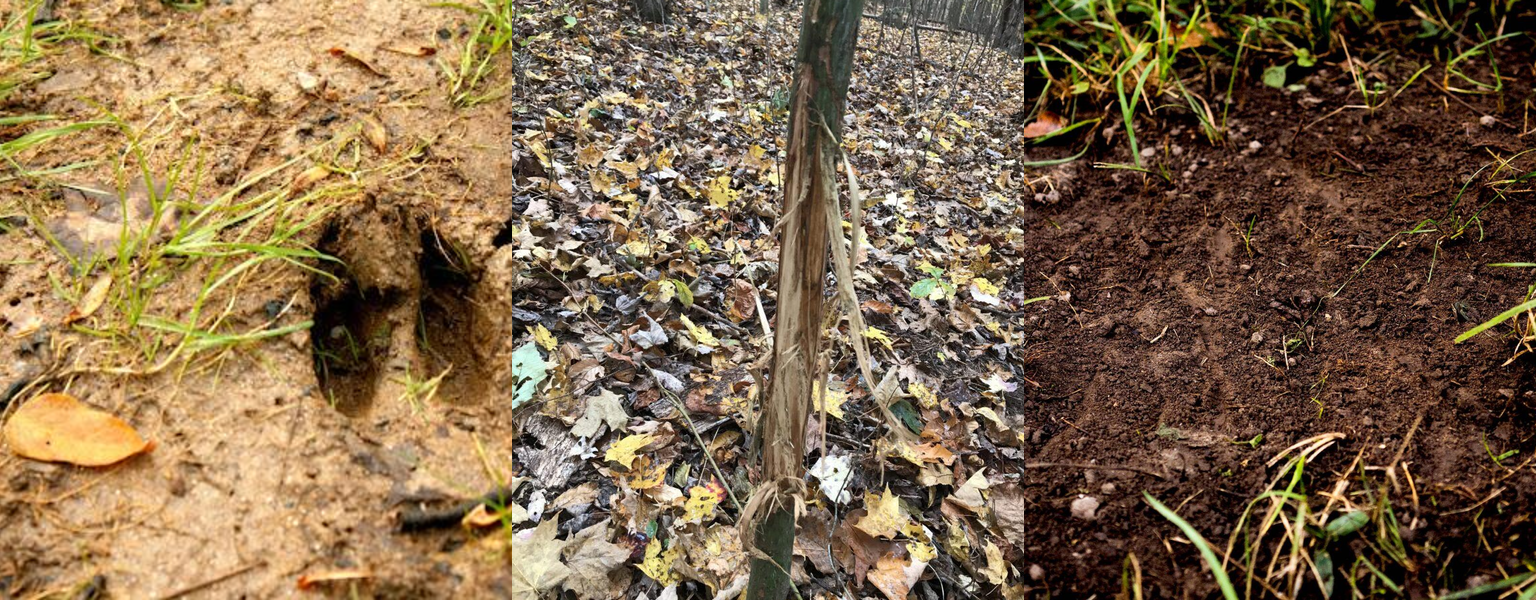
Well, I guess that ain't exactly fair to the deer, because the sign ain't really doing any lying. Most of the lying gets done by us hunters after we find it. A man sees one big track in the mud and by the time he makes it back to camp that deer weighs two hundred and forty pounds, has twelve points, a drop tine, and apparently walks that same trail every evening at five-thirty. Ol' Red is especially talented at that sort of thing. Years ago we were slipping down an old logging road after a rain when Red stopped so fast I nearly walked over the top of him. He bent down, studied one track for a minute and whispered, "Big buck." I asked him how he knew. Red pointed at that track like I had just asked the dumbest question he'd heard all year and said, "Because it's a big track." Well, that sounded pretty good for about another hundred yards, until the owner of those tracks stepped out of the palmettos and turned out to be a big old doe. Red didn't say much after that. I waited until she disappeared and asked him how many points she had. That little episode taught me something I've remembered ever since: one piece of sign can tell you something, but it usually can't tell you everything.
That is really the first thing a hunter has to understand if he wants to get good at reading deer sign. You aren't looking for one magical track, one giant rub, or one scrape big enough to park a four-wheeler in. You're trying to put together a story. A track tells you a deer walked somewhere. A trail tells you deer keep walking there. Fresh browse tells you deer are feeding there. Beds tell you where they felt safe enough to lay down. Rubs tell you bucks are using an area, and scrapes tell you deer are communicating there. When several of those things start showing up together, especially when they are fresh and make sense with the terrain, food, cover, wind and time of year, then you aren't just finding sign anymore. You are starting to understand what those deer are doing and why they are doing it.
Tracks are the easiest place to start because everybody recognizes one. A whitetail hoof leaves those familiar two pointed halves, and if the ground is good enough you can usually tell direction without much trouble. Front tracks tend to be larger than rear tracks because a deer carries more weight over its front end, but what I care about more than the size of one print is what the whole line of tracks is doing. Are they coming out of thick cover and heading toward a food source? Are they walking along a creek bank until they reach the easiest crossing? Are several sets funneling through a break in a fence? Are they following a ditch, edge, saddle, narrow strip of timber, or some other piece of ground that naturally makes travel easier? Indiana wildlife biologists have pointed out for years that deer develop repeated travel routes and often take paths of relatively low resistance. That ought to make sense to anybody who has ever walked through the woods. If there is one easy gap through a nasty fence and everything else is a tangled mess, a deer is pretty likely to find that gap just like you would.
Freshness matters with tracks too, but this is another place hunters get carried away. I have heard men look at a print and tell you it was made "sometime between eight and ten last night" like the deer had signed his name and left the time underneath it. Most of the time you can't know that. What you can do is compare the track to the weather and the ground around it. If you had a hard rain at midnight and find a sharp, clean track sitting on top of rain-washed mud at daylight, that deer came through after the rain. If the track is in powder-dry sand that has not seen rain in two weeks, you can tell whether it looks fresher or older than the tracks around it, but you better not set your watch by it. Rain, wind, sun, freezing, thawing and other animals all work on tracks. A good woodsman learns to judge whether sign is fresh enough to matter instead of pretending he can age every hoofprint down to the hour.
And while we are down there looking at tracks, we might as well get rid of some old campfire nonsense. A big track can certainly come from a big deer, and mature bucks are often bigger-bodied animals, so a really large walking track can get my attention. But there is no dependable rule that lets you look at an ordinary track and announce buck or doe with complete certainty. Dewclaws showing do not automatically mean buck. Splayed toes do not automatically mean buck. Toe drag does not automatically mean old buck. Ground softness, speed, snow depth, sand and the way an animal was moving can change all of that. Missouri conservation officials have specifically warned hunters not to use dewclaw impressions as a sex test, and other wildlife educators say the same thing about scat size and shape. Now, if I find a great big track, fresh rubs, an isolated bed and a scrape line all in the same piece of thick cover, I'm going to start thinking buck. But notice what happened there: I did not make that decision from one track. I let several pieces of sign agree with one another.
Once you start paying attention to tracks, deer trails begin showing themselves everywhere. Some are worn right down to bare dirt, and others are nothing more than a little path through leaves and grass that you might miss if you are walking too fast. A heavy trail tells you deer are using that route often, but it does not automatically tell you a big buck is walking it in daylight. Does, fawns and young deer can beat a trail into the ground. Ol' Red proved that one to himself years ago when he found what he called "the buck interstate" and hunted it three afternoons straight. He saw eleven does, half a dozen young deer and one squirrel that nearly caused him to climb out of the stand backwards. He never did see the buck he had imagined. The trail was good deer sign. Red's mistake was asking the trail to tell him something it couldn't.
When I find a good trail, I want to know what it connects. A trail going from thick bedding cover toward an oak flat is telling me something. Three trails squeezing through the same creek crossing are telling me more. A little strip of timber connecting two bigger chunks of cover can be a highway simply because deer do not have many other secure choices. Wildlife agencies talk about funnels, pinch points, creek crossings, fence gaps and habitat edges because those places concentrate movement. The fancy words are fine, but the idea is simple: find where deer have fewer sensible choices about how to get from one place to another. That is often where their sign piles up.
Beds are another piece of the puzzle that hunters can learn a lot from if they resist the urge to turn them into something mystical. A deer bed usually looks just like you would expect—an oval patch of flattened leaves, grass or vegetation where the animal laid down. The important part is not only the bed itself but where it is sitting. Mature deer like security. Mississippi State researchers using GPS-collared adult bucks found that heavily used bedding locations had considerably more screening cover than areas inside those same bucks' home ranges that they rarely used. In plain English, those bucks were choosing places where they felt hidden and protected. That ain't exactly shocking news to anybody who has tried to sneak up on one, but it is nice when a GPS collar proves that the old deer-camp wisdom was right about something.
What did surprise a lot of hunters when researchers began putting GPS collars on mature bucks was just how many bedding areas an individual buck may use. The old picture of one giant buck having one secret bedroom where he sleeps every day is too simple. Bucks can shift between bedding locations depending on wind, weather, hunting pressure, food and the time of year. So when somebody comes back to camp and says, "I found his bed," I usually tell him he might have found one of them. If you find a large isolated bed buried in good security cover, with a big track in it and other fresh buck sign close by, that is important information. It still does not mean the deer signed a lease.
The biggest mistake hunters make around bedding sign is staying too long. Once you know you have found a bedding area, there comes a point where every extra step is costing you more than it is teaching you. I have seen men crawl through a thicket for forty-five minutes looking for one more track, one more hair, one more rub and one more clue, then wonder why the place seems dead when they hunt it. Well, you walked through the deer's bedroom touching limbs, breaking brush and leaving scent everywhere but the ceiling. Sometimes the best scouting decision you can make is to say, "That is enough," and back out.
Droppings are not as exciting as rubs, but they can tell you a lot about how much time deer are spending in an area. Everybody knows the familiar pellet-shaped deer droppings, but they do not always look the same. Diet and moisture make a difference. When deer are eating lush, watery vegetation, droppings can be softer and clumped together. When the diet is drier and more fibrous, you tend to see those separate pellets everybody recognizes. That is why the old claim that clumped droppings mean buck and separate pellets mean doe is not something I would bet my supper on. Wildlife educators have warned against trying to sex deer from scat because food affects it too much. What I do care about is how much of it I am finding, how fresh it appears, and what else is around it. Fresh droppings scattered all through a feeding area, with tracks and freshly bitten vegetation around them, tell me deer are spending time there right now.
That brings us to browse, which may be the most overlooked deer sign in the woods. Hunters love big rubs because they are obvious. They love scrapes because they look exciting. Meanwhile, the deer are walking around eating evidence all over the place and half the hunters never notice it. Whitetails are selective feeders. They eat tender leaves, buds, new growth, vines, forbs, greenbrier, blackberry and all sorts of woody browse depending on the habitat and season. Deer do not have upper front incisors like we do, so when they bite woody stems they tend to tear or pinch them instead of making a perfectly clean cut. Once you learn that rough, torn look, you start seeing deer feeding sign everywhere.
You also start understanding why a place that was crawling with deer last month can suddenly look dead. Food changes. That is one of the biggest lessons in whitetail hunting. Tender plants mature and lose quality. New plants emerge. Agricultural fields change. Fruit ripens. Acorns start falling. Cold weather changes what is available and what deer need. Research across the Southeast has shown how strongly food selection changes with the seasons, and UF/IFAS has noted that deer may shift heavily into oak-dominated woods when acorns are abundant. I have seen hunters sitting over a feeder complaining that the deer "quit moving" while fifty yards into the woods those same deer are vacuuming up acorns like somebody turned them loose at a buffet. The deer did not necessarily quit moving. They changed restaurants.
Rubs are where most hunters' blood pressure starts climbing a little. A freshly rubbed tree with bright exposed wood and bark laying around the base will still stop me in my tracks, and I have been looking at them a long time. Bucks rub trees with their antlers and forehead, and research has shown that rubbing is more than a way to remove velvet or work the neck muscles. Rubs are part of a buck's communication system. Scent glands around the forehead and antler area leave chemical information on rubbed trees, making them both a visual and scent signpost. Other deer notice them. That means a rub tells you more than simply, "A buck scratched this tree."
The trick is not getting carried away with the first one you find. A fresh rub is interesting. A cluster of fresh rubs gets more interesting. A line of fresh rubs following a travel corridor, especially when mixed with big tracks, good cover and other buck sign, is something I am going to study carefully. Where does that line lead? Is it coming out of thick cover? Is it headed toward food? Is it running along the downwind side of an area deer use? Does it go through a pinch point? Those rubs may not tell you exactly when a buck passes, but they can help show how bucks are using that piece of ground.
And no, a giant rub does not automatically mean a giant rack. Older bucks are capable of rubbing larger trees and research has found that older age classes tend to use bigger-diameter trees more often than yearlings, so tree size can be one clue. But mature bucks rub small trees too, and multiple bucks can use the same rub. Researchers have also found deer select certain tree species and bark characteristics more than others. So if you find one big cedar rubbed up like somebody attacked it with a chainsaw, enjoy it, but do not start ordering the shoulder mount. If you find several big fresh rubs, large tracks, fresh scrapes and isolated bedding sign all stacked together, now those clues are beginning to reinforce one another.
Scrapes may be the most misunderstood buck sign of all. A classic scrape usually has disturbed ground underneath an overhanging licking branch, and hunters have spent generations treating some scrapes like personal mailboxes owned by one giant buck. Camera research has shown that is not how it works. One recent large field study monitored 107 scrapes for 7,385 camera-days and recorded more than 3,000 interactions involving 218 identifiable bucks. Read that number again: 218 different bucks. Does and fawns used those scrape sites too. Scrapes are more like community communication centers than a private mailbox belonging to one deer.
That same research showed something else hunters ought to remember before they hang a stand directly over every scrape they find: a great deal of scrape activity happens after dark. In that study, roughly two-thirds of recorded scrape interactions occurred at night, and older bucks showed especially limited daylight use of scrape sites. Other camera research on wild deer has found the same general pattern. That does not mean scrapes are useless. Far from it. It means you have to read the scrape in the context of where it sits. A big scrape on the edge of an open field may get hammered at midnight. A scrape tucked inside secure cover on a route between bedding and food may be part of a much more useful daylight pattern. The dirt is only part of the clue.
And while everybody is staring at the scraped ground, do not forget to look up. The licking branch may be the most important part of the whole scrape. Deer sniff it, lick it, rub their forehead against it and leave scent there. In that large scrape study, licking-branch interaction was much more common than a lot of the ground behavior hunters usually focus on. So if you are scouting scrape country, look at the branch. Is it broken, twisted or heavily worked? Are there tracks approaching from more than one direction? Are there rubs nearby? Does the scrape sit where several trails meet? Why did the deer choose that spot instead of another one twenty yards away? The more questions you answer, the more useful the scrape becomes.
Eventually you have to get your nose off the ground and look at the whole piece of country, because terrain gives meaning to all that sign. A rub in the middle of eighty acres of identical woods is one thing. A rub line crossing the only dry strip between a swamp and a bedding thicket is something else. A track anywhere along a creek does not excite me much. A pile of tracks at the only shallow crossing for four hundred yards certainly does. A scrape is a scrape. A scrape sitting where two ridges pinch together between bedding and food may be worth remembering. Good deer hunters learn to look at sign and landscape at the same time.
Wind belongs in that picture too. A buck may choose bedding cover, travel routes and staging areas partly because they give him a scent advantage. That does not mean every buck always walks with the wind perfectly in his favor; deer would never get anywhere if they followed some of the rules hunters invent for them. But scent matters to a deer every minute of his life. When you find a trail, rub line or bedding edge that makes sense with the prevailing wind, that is another little piece of evidence to add to the pile.
Hunting pressure changes everything as well. GPS-collar studies from Mississippi State have shown adult bucks change how they use areas as hunting risk increases. They may reduce daytime use, avoid heavily pressured locations or shift more activity around food sources into darkness. That is why you can walk into a spot absolutely covered in tracks, droppings, scrapes and rubs and still sit there three evenings without seeing a mature buck. The sign did not lie to you. The deer may simply be using that area when you are not there. Hunters often ask, "Is he using this place?" when the more important question is, "When is he using it?"
That is one reason I pay close attention to the sign just inside security cover. A food plot may look like somebody turned a herd of cattle loose in it every night, but if an older buck will not step into that opening until after dark, the better hunting information may be fifty or a hundred yards back inside the timber. Look for the trail he uses before reaching the field, a staging area where tracks and rubs start collecting, or a scrape tucked far enough inside cover that a buck feels safe checking it before daylight disappears. Sometimes the destination everybody is watching is not nearly as important as the route getting there.
The same thing happens with acorns and other natural foods. If you walk into an oak flat and find freshly cracked shells, torn browse, droppings and multiple sets of tracks, you know deer are feeding there. Now look around the outside of that feeding area. Where is the thickest cover? Where are the easiest approach routes? Which side lets a deer enter while staying hidden longest? Where are the rubs? If you can connect fresh feeding sign to a secure bedding area with a trail or funnel in between, you have learned a whole lot more than a man who simply found some deer poop under an oak tree.
That is really what separates a hunter who finds deer sign from one who reads it. The fellow who finds sign says, "There are deer here." The fellow who reads it says, "They are bedding in that thick stuff, coming out through this little ditch, feeding on those acorns, and most of the heavier buck sign is on the inside edge where they still have cover." Neither one has seen the deer yet, but one of them has a plan.
And you will still be wrong sometimes. I promise you that. Anybody who tells you he can read the woods perfectly has either not hunted very long or is trying to sell you something. Deer have embarrassed better hunters than you and me. Weather changes them. Food changes them. Hunting pressure changes them. The rut changes them. A neighbor walking his dog changes them. Sometimes a buck just does something because he is a deer and nobody remembered to give him a copy of the hunting article explaining what mature bucks are supposed to do.
That is what keeps it interesting.
I have been reading deer sign most of my life and I still find things that make me stop and scratch my head. But over the years I have learned not to force an answer when the woods have not given me enough evidence. One old rub does not make a buck pattern. One big track does not make a mature buck. One scrape does not mean a buck will stand over it tomorrow afternoon. You keep looking until different clues begin pointing in the same direction.
Fresh tracks tell you deer were there recently. A worn trail tells you they use that route repeatedly. Fresh browse and droppings tell you why they may be spending time there. Beds and thick screening cover tell you where they feel safe. Rubs tell you bucks are using the area. Scrapes show you where deer are communicating. Terrain tells you how all those places connect. Wind and pressure help explain when the deer may feel comfortable moving between them.
Now you have a story.
And once you can read that story, you quit wandering around the woods hoping to bump into a deer and start hunting the reason that deer is there.
That is woodsmanship, and there ain't an app, trail camera, GPS collar, fancy bow or thousand-dollar rifle that can replace it. All those things can help you, and some of them can help a lot, but sooner or later you have to stand in the woods, look around and understand what you are seeing.
Ol' Red still claims he can tell a buck track from a doe track every time.
I remind him about that big doe whenever he gets too confident.
He says that happened so long ago it ought not count anymore.
I tell him deer tracks don't have an expiration date on embarrassing stories.
So the next time you are scouting, slow down. Don't just look for the biggest rub or the prettiest scrape. Look at everything around it. Look at the tracks, the trails, the food, the beds, the terrain and the cover. Ask where those deer came from, where they are going and why they chose that particular route.
Do that long enough and something changes.
The woods stop looking like a bunch of trees.
They start looking like a map written by the deer themselves.
You just have to learn how to read it.
The woods don't mind teachin' ya, but the lessons ain't cheap.
— Waylon Dixon