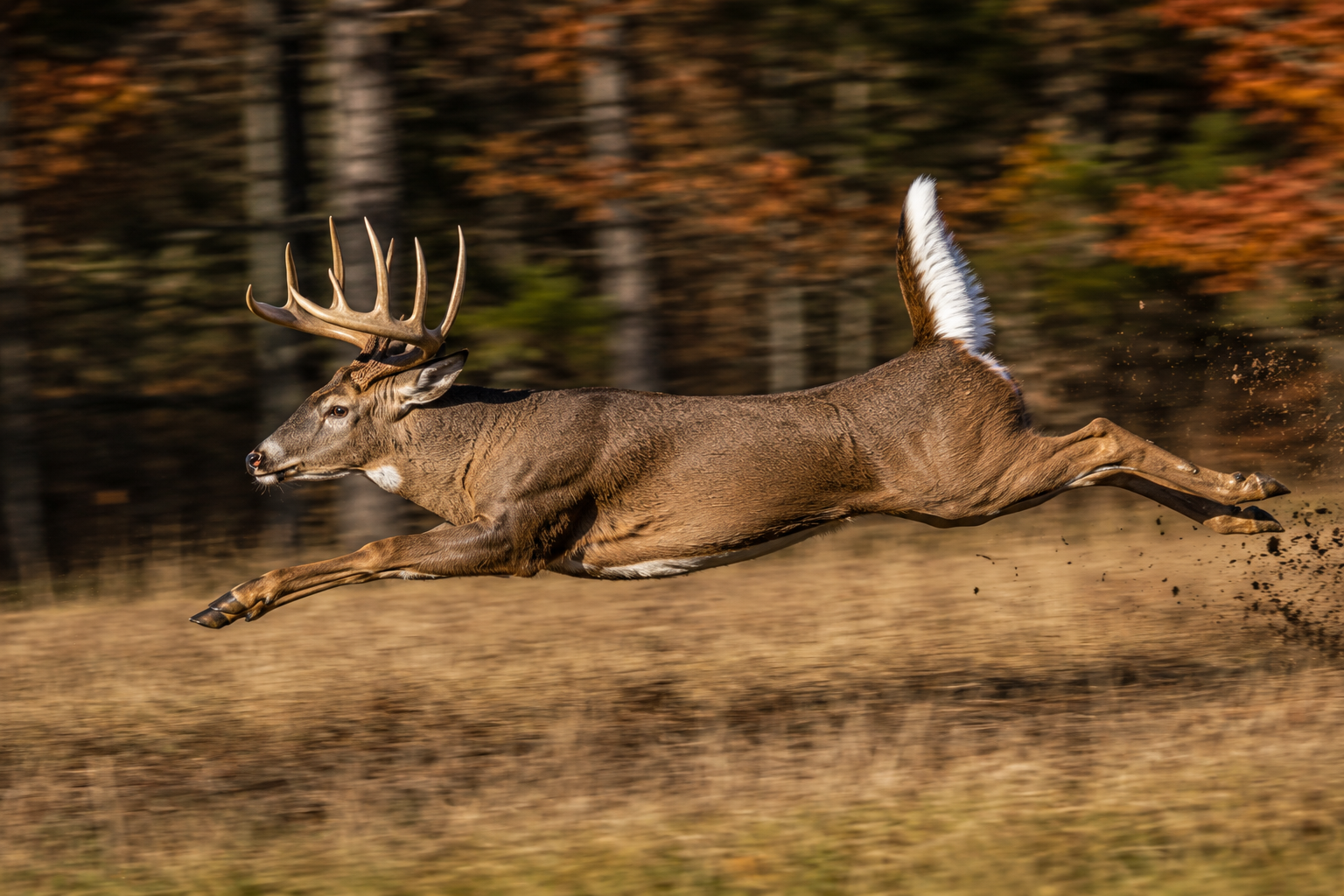
Ask five hunters and you'll probably get seven answers. One fellow will tell you thirty miles an hour, another swears it is forty-five, and somebody sitting near the fire will eventually claim he once saw a buck running beside his truck at fifty-five. That last story usually gets better every year. By the time the man is seventy, the buck will have passed him, jumped a cattle gate, crossed two counties and beaten Dale Earnhardt to Talladega.
The truth is plenty impressive without helping it along. Depending on which wildlife agency or research source you read, a healthy white-tailed deer is generally credited with a top running speed somewhere around 30 to 35 miles per hour, with some wildlife authorities reporting that a whitetail can touch roughly 40 miles per hour during a short burst. That difference does not mean somebody forgot how to operate a stopwatch. Deer are living animals, not pickup trucks coming off the same assembly line. Body size, age, physical condition, terrain, footing, snow, brush and how badly that deer wants to get away all matter, and measuring the absolute top speed of a wild deer running through the woods is a little harder than putting one on a racetrack and waving a green flag.
Whatever number you settle on, though, thirty-something miles an hour is getting with it. At thirty miles an hour, a deer moving at full speed is covering about forty-four feet every second, which is almost fifteen yards. Give him five seconds at that pace and, on paper, you are already talking about more than seventy yards. At thirty-five miles an hour, the distance piles up even faster. Now, a deer does not teleport from standing still to full speed and he is not likely to hold perfect top speed through palmettos, blowdowns, creeks and briars, so don't take those numbers and start measuring every deer run with a stopwatch. The point is simpler than that: when a whitetail decides to leave, a whole lot of ground can disappear underneath him in a mighty short time.
Ol' Red learned that one in a food plot years ago. We had been watching a little group of does when something spooked them. To this day Red claims it was a coyote. I say it was Red trying to open a Little Debbie wrapper without making any noise, which has probably scared more deer in the Southeast than coyotes ever have. Whatever caused it, those deer went from standing still to gone so fast that Red looked at me and said, "Ain't no way something with legs that skinny ought to be able to do that." He had a point. A deer doesn't look like much of a running machine when he is standing still feeding, but everything about those long legs, powerful hindquarters and light frame is built to put distance between him and trouble.
And speed is only half of what makes them so hard to follow with your eyes. Whitetails do not have to run down a paved road. They can bound through brush, change direction, cross rough ground and clear obstacles that would put most of us in an ambulance. Wildlife agencies commonly report whitetails clearing obstacles around seven or eight feet high, and some authorities put their jumping ability even higher under the right conditions. Anybody who has watched one sail across a fence knows what I mean. He doesn't stop, take three practice steps and think it over. One second he is on your side of the fence and the next second he is somebody else's problem.
They are good swimmers too, which surprises folks who only picture deer in hardwoods and food plots. Whitetails will enter rivers, lakes and other water to travel, escape danger and reach habitat on the other side. Their winter guard hairs contain air and help provide buoyancy, and wildlife agencies consistently describe them as capable swimmers. So if you are following deer sign toward a creek, river or swamp and somebody tells you, "He wouldn't cross that," I would be mighty careful with the word wouldn't. Deer have not read nearly as many hunting rules as hunters have written for them.
Running Fast and Traveling Far Ain't the Same Thing
This is where a lot of the confusion comes from. A deer being capable of running thirty or thirty-five miles an hour does not mean he can cruise along at that speed all afternoon. Top speed is an escape gear. It is what that animal uses when something has convinced him staying where he is might get him killed. Wildlife sources describing whitetail speed are careful about this. The highest speeds are generally described as bursts or speeds that cannot be maintained for long distances.
Most of a deer's day is nothing like that. He walks, feeds, browses, beds, stands, trots and travels between the things he needs. In Florida, UF/IFAS describes whitetails as crepuscular, meaning activity is often greatest around dawn and dusk, although anybody who has hunted long enough knows deer can move at just about any hour when weather, pressure, rut activity or food gives them a reason. A deer slipping from bedding cover toward acorns is not trying to break a land-speed record. He may stop every few yards, feed, test the wind, listen, look around and ease along like he has nowhere else to be. Put danger behind him and that whole attitude changes in about half a heartbeat.
Terrain makes a difference too. Deep snow can slow deer dramatically. Thick blowdowns and tangled cover take away some of their speed. Open ground gives them a chance to stretch out. Established trails make travel easier. Researchers studying deer and predators have found that whitetails use terrain and habitat in ways that can improve their ability to detect danger and escape it. That makes sense when you think about how often a deer trail takes the easiest path through a piece of nasty country. That trail is not only saving energy on an ordinary Tuesday afternoon; it can also become an escape route when something starts chasing him.
That is one reason I tell hunters not to look at a deer trail as nothing more than a path between point A and point B. A well-used trail through a creek crossing, fence gap, saddle or strip of open ground tells you deer have learned that route works. If you bump deer out of a bedding area, there is a pretty good chance one of those established routes is going to become important in a hurry. You can learn a lot by watching where a startled deer goes instead of spending the whole time fussing because you spooked him.
Now Let's Talk About the Question Hunters Really Mean
Most hunters who ask me how fast a deer can run are not sitting around wondering whether a whitetail could outrun them in a hundred-yard dash. I can save you the suspense on that one. Unless your hunting buddy happens to be an Olympic sprinter and the deer agrees to give him a head start, put your money on the deer.
What hunters usually want to know is something more important: How far can that deer go after I shoot him?
And this is where I want everybody to quit looking for one neat little answer, because there isn't one.
You will hear camp rules such as, "A double-lung deer never goes more than a hundred yards," or, "If he made it two hundred, you didn't hit him right." Those sayings may be based on a lot of deer somebody has personally seen, but they are not laws of biology. Shot placement, angle, weapon, penetration, which organs and blood vessels were damaged, whether there is an exit wound, the deer's condition, whether he was already excited, terrain and whether he gets pushed can all change what happens next.
Penn State's Deer-Forest Study has made an important point on this subject. Deer have a powerful cardiovascular system built to move a lot of oxygen. Their biologists note that even when the heart is no longer effectively pumping after a lethal heart-and-lung-area hit, a deer may still have enough available oxygen in its body and muscles to run several hundred yards before that supply is exhausted.
That does not mean a good heart or double-lung hit normally produces a three-hundred-yard tracking job. Many deer collapse much sooner, while others may travel considerably farther depending on the exact damage and the circumstances surrounding the shot. What it means is that distance by itself does not prove what you hit.
A deer can cover fifty yards before you finish finding your binoculars, and at full escape speed, a hundred yards can disappear before a hunter has fully processed the direction in which the animal ran. A mortally wounded animal does not necessarily understand that it is mortally wounded, either. Its nervous system registers that something terrible has happened, adrenaline begins moving through its body, and every survival instinct it possesses tells it to put as much distance as possible between itself and whatever caused the injury.
That is why watching the deer after the shot matters so much. Don't immediately start celebrating, texting everybody in camp and trying to remember where you left your knife. Watch him for as long as you can. Watch the direction he leaves. Pick a tree, stump, palmetto clump, fence post or some other landmark where you last saw him, and listen after he disappears because sometimes you will hear crashing, a fall or leaves moving after you can no longer see the deer.
The more you remember about those first few seconds, the less guessing you have to do twenty minutes later.
A Deer That Is Hurt Can Still Be a Mighty Athletic Animal
This is another place hunters sometimes get fooled. We see a deer hit hard and expect him to immediately start behaving like a badly wounded animal, but the animal's response is not always so obvious. A deer can run on injuries that would put you and me flat on our backs asking somebody to call an ambulance because adrenaline and survival drive are powerful things. A deer that has been lethally hit may still clear a fence, cross a creek, climb a bank or make it through cover you were certain he could not possibly get through.
That is why I don't like saying things such as, "A hurt deer won't cross water," or, "A mortally hit buck always runs downhill," or, "If he crossed that fence, he can't be hit very bad." Sometimes wounded deer head toward thick security cover, sometimes they use familiar trails, sometimes they go downhill, and sometimes they head toward water. At other times, they do something that makes absolutely no sense to the hunter standing there trying to turn deer behavior into a rulebook.
Pay attention to tendencies, but never confuse a tendency with a promise.
Ol' Red once spent half an afternoon insisting a buck couldn't possibly have crossed a creek because, according to Red, "A deer hit that hard ain't gonna fool with swimming." We found blood on the opposite bank, and Red looked at it for a while before finally saying, "Well, apparently this one didn't know that." That might be the smartest thing Red ever said about deer.
How Far a Healthy Deer Can Travel Is a Different Question Entirely
A healthy whitetail's ability to move across country goes far beyond however far it can hold a sprint. Deer routinely travel between bedding, food, water and seasonal areas, and movements can change dramatically during the rut, with disturbance, with changing food sources and with seasonal conditions. Northern deer may make substantial movements between seasonal ranges, while deer in other habitats may spend most of their lives inside relatively compact home ranges.
So when somebody asks, "How far can a deer go?" you have to ask what kind of going we're talking about. A deer cannot sprint flat-out as far as it can travel at a walk or trot, but it may cover miles overnight depending on its condition, habitat and circumstances. A buck may also travel considerably farther during the rut than he does during an ordinary week, while a mortally hit deer may travel anywhere from a handful of yards to considerably farther than the hunter expected.
Those are four different questions, and trying to answer all of them with "about a hundred yards" is how bad information gets started.
What This Means After the Shot
For a hunter, all this biology boils down to something pretty simple: do not use distance as your only judge of the hit. Use everything you observed, including where the deer was standing, what the shot angle was, where your arrow or bullet appeared to hit, how the deer reacted, whether he kicked, hunches up, drops low, runs normally or stumbles, and whether you heard anything after he disappeared.
The sign at the impact site matters too. Pay attention to the kind of hair you find, the appearance of the blood, whether an arrow is available to examine, whether there is stomach material, and whether the blood is bright red, dark red, watery, pink and bubbly, sparse or heavy. Most importantly, consider what all of that evidence says together, because one clue can fool you while several clues agreeing with each other provide a much stronger basis for deciding what to do next.
That is the same lesson I keep coming back to with deer sign. If you have evidence of a questionable hit, don't let the fact that the deer ran strongly convince you he is fine, and don't let the fact that he disappeared quickly convince you he must be laying fifty yards away. Give the evidence more weight than your hopes.
There are few things worse in deer hunting than taking up a trail too soon because you are anxious to see antlers on the ground, jumping a deer that was bedded and turning a recoverable animal into a much longer tracking job. Knowing that a deer is capable of tremendous speed ought to make us more patient, not less, because a deer that gets up out of a wound bed and decides to leave again can put an awful lot of country behind him before you realize what happened.
Waylon's Answer to the Original Question
So how fast can a whitetail deer run? Call it around 30 to 35 miles per hour at the upper end, with some wildlife authorities reporting short bursts approaching 40 miles per hour. Don't get hung up arguing over five miles an hour. Either way, he is considerably faster than you are, faster than he looks standing in a food plot, and capable of covering a hundred yards in a surprisingly small number of seconds once he gets moving.
How far can he run at that top speed? There isn't a good universal number, and anybody giving you one without qualifications is making things simpler than nature made them. Full sprint is for escape and isn't something a deer can maintain indefinitely, while terrain, footing, physical condition and motivation all influence how much ground he can cover before slowing down.
How far can a deer travel? Much farther than he can sprint, because ordinary movement, nighttime travel, seasonal movement and rut-related travel all involve different speeds and different physical demands.
And how far can a deer go after the shot? That depends on what was hit, how badly it was hit, the shot angle, the deer's condition, terrain, whether the animal is disturbed again and a pile of other things. A properly hit deer may fall quickly, but biology tells us even a lethally hit whitetail can sometimes cover far more ground than a hunter expects.
That's the part worth remembering. A hundred yards looks like a long way when you're standing beside your tree trying to find the first drop of blood, but to a frightened whitetail capable of running thirty-something miles an hour, a hundred yards ain't much real estate at all.
So watch carefully, mark where he was standing, mark where you last saw him and pay attention to the evidence. Don't rush in just because you are excited, and don't quit just because the deer went farther than somebody at camp said a "good-hit deer" is supposed to go. The deer doesn't know the camp rules, and the woods have a bad habit of proving that right about the time a hunter gets certain he knows everything.
The woods don't mind teachin' ya, but the lessons ain't cheap.
— Waylon Dixon